

Within the scope of Latvia, the Suiti area, one of the most conservative Latvian areas, was the one who kept practicing not only its traditional customs and beliefs, but also its music arts of ancient Latvians, for the longest time. Speaking of musical instruments, as recent as in the 1930’s there were still people who could tune and play kokle instrument. At the same time, also bagpipes (dūdas), in German called dudelsack, in French cornemuse, once popular in Europe, had not yet disappeared in the Suiti area. The Roman buccina (bukurags) was played too. The oldest generation still has the skills to make pipes and shepherd’s horns. Not to forget trideksnis – ancient percussion instrument that helped to accentuate the rhythm of dance or song. 1924. On spring of 1924, the Suiti people still could play these instruments and managed to surprise Riga, by making these ancient instruments emit extremely fluent and soft sounds, combined with signing.


Trideksnis is very ancient. This type of instrument was made from metal, usually iron, shaping it into a vertical stick with a wooden handle. Rattling copper plates were threaded onto the trideksnis in several layers. When striking the instrument, these plates jingled. Trideksnis was generally played by women.
Bagpipes are known to be popular in Latvia, since the 16th century, according to written evidence of numerous sources. However, presumably, they trace back to much earlier periods. Bagpipes were made from skin of lamb or goat kid, skinned whole, tanned and turned inside out. The ending was fastened as a bag. In the place of one foreleg a blowing pipe was fitted in – mouthpiece, while in the place of the other foreleg – the so called patterned pipe with 4-7 sound outlets to play melodies. The hind legs were replaced by one or two wide pipes that emitted low solid sound. In most cases one wide pipe was enough – bass drone that was fitted into the neck hole. The sound of pipes is created by the air blown into the bag, while the performer squeezes the bag between the armpit and elbow. Earlier, at celebrations, especially weddings bagpipes were popular not only as solo-instrument, but also accompanied by other instruments, such as pipes, kokles, bugles and violin. They were used to play dance music.
Bagpipes were at the peak of popularity in in the 17th and 18th century. In Alsunga, the bagpipe tradition, practiced in natural environment has survived the longest, comparing to the other Latvian areas. In the second half of the 19th century the Suiti bagpipers had the honour to play for Nicholas, the heir to the Russian throne, during his visit to Liepāja. At that moment, the Suiti musician band consisted of seven bagpipers and eight men playing buccina. It was Alsunga, where Jurjānu Andrejs and Emilis Melngailis wrote down the majority of bagpipe melodies. Bagpipes began disappearing due to growth of choir culture and introduction of other more modern instruments (mainly violins) in daily life.
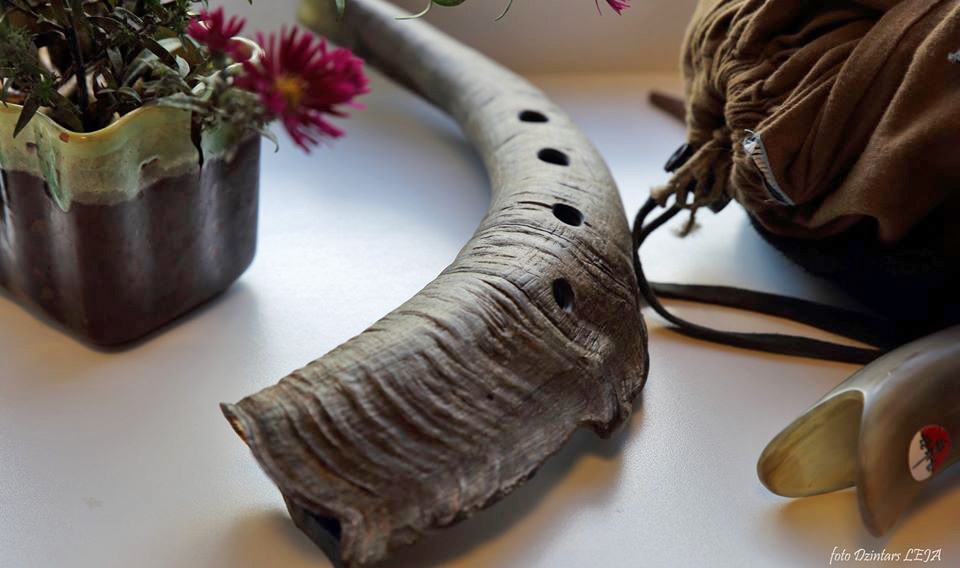
Buccina refers to a wind instrument, made from horns of cattle or forest animals Sometimes buccina was produced from a ram horn. It was 15-20 centimetres long usually. Into the blowing part – the narrowest end – there was a small hollow cut made for lips. One side of the horn had 3-5 sound outlets cut out. The melody range was rather limited. It sounded strong, flump and far. Generally boys blew buccina, as it required good lungs to make a good sound. In the view of E. Melgailis, the buccina melodies in Alsunga seemed rather ancient (archaic). Buccina is mainly a solo-instrument, only sometimes combined with bagpipes. It was also used as sound device during farm works, shepherding and night-watch.
Trumpet is the instrument mentioned in folk songs most often. Its musical options were quite limited, though. Trumpets were made from various materials. It could be made from two split and carved out chips of alder, fir, hazel, maple or pine, wrapped into wicker strips or birch-bark. The narrowest upper end had a hollow cut for lips, where the mouthpiece was fitted in. After making the instrument, it was soaked in water for a while, to make the best sound. A trumpet could also be made from birch-bark or alder-bark wrapped into a cone. Such trumpet was straight, 0.6-1.5 m long or curved and resembled a horn. To make a trumpet, a 5-7 cm wide bark was peeled off a young tree, in spring. Unlike buccinas, trumpets did not have any special sound outlets. Therefore, only the natural sound range was blown out. Trumpet generally functioned as a signal-instrument. Trumpets were also used in weddings to make more noise.


Drums have always been significant in people’s lives as a signal-tool and rhythm instrument. Drums were usually made from dog or goat skin.
String instruments are more recent than wind instruments. Latvian folk music could not do without kokle, just like its counterpart kankle, kannele or kantele in Lithuanian, Estonian and Finnish folk songs respectively. Kokle is suggested to have been a Baltic musical instrument initially.
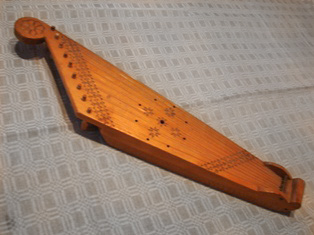
In written evidence, kokle was mentioned from the 16th and 17th century. The Kurzeme type of kokle was carved from one type of wood and covered with a thin board with sound outlets cut out. Initially the strings were produced from intestines. The kokle edges were decorated with cut marks. The dimensions of Kurzeme kokles are: length 50-70 cm, width 10 cm and height 4-6 cm, of roundish shape. The kokle ends are slightly curved upwards. The bridge pins are lined along the widest kokle ending, beside it. The strings were usually coiled around a metal rod fitted into a U-shaped log on the narrowest end. Sometimes they did without the log and fitted the rod into the housing. The longest edge on the left side of the kokle had shape of thread or snail and often was decorated with cut winding ornaments or notches. For hanging function, sometimes a hole was drilled or cut into the centre of snail or thread part. The strings were free and were not supported by any extensions or thresholds (unlike the modern products), thus they sounded rather silent, but long and colour-rich. In the course of time the string count increased up to 17. 17.


Light Kurzeme kokles are especially beautiful and unique in their production and finish style. Their edges are frequently decorated with carved geometrical ornaments. At the same time, small symbols of circle, sun, star, cross cut out in the surface are not just structural features of the instrument – they also demonstrate the sense of beauty of kokle makers. Nikolajs Heņķis from Alsunga, who once was a well-known musician of various folk instruments and spectacular kokle player (acknowledged even by E. Melgailis), as well as proficient kokle craftsman, once said: “before making a kokle, take and study various types of wood you have or can get from others. It is best to have in mind, what your expectations from the kokle are. Do you want it to sound silent and soft, jolly or loud or what?” For kokle housing, N. Heņķis tried out different types of wood – lime-tree, birch, aspen tree, yet the sound board was always made from fir. Nevertheless, he claimed the best wood for kokle housing was lime-tree. The kokles deposited in museums are generally made from lime, though there are some counterparts from birch, aspen-tree, ash-tree, pine, alder, willow and even oak.
While playing kokle, it is held in lap or put on table. The instrument starts emitting sound by string vibration. The strings vibrate, upon strumming by fingers of right hand, or by using a special stick, goose feather or piece of leather. The unnecessary sound is muted by the left hand. While walking or riding, kokle was hung by a tie on the shoulder. Kokle was used both as solo and band instrument. At celebrations, kokle was played together with pipes, violins and drums.


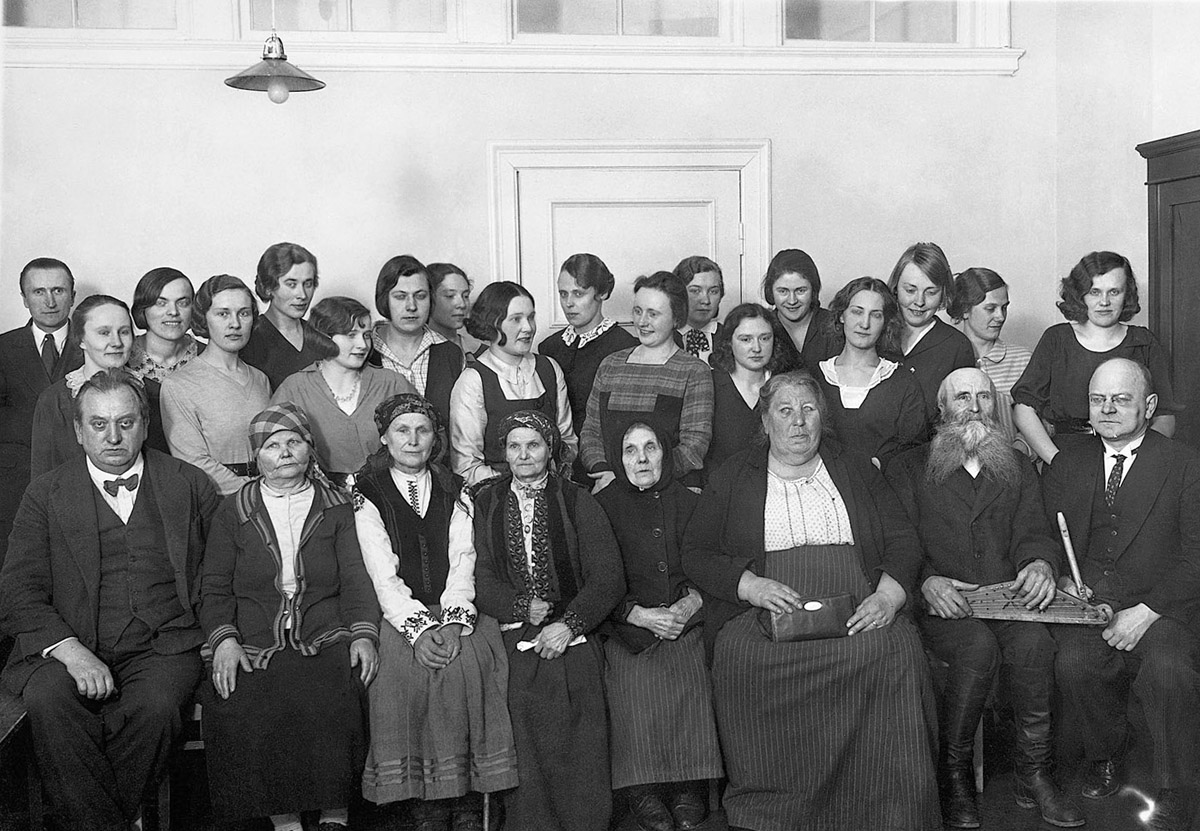
Nikolajs Heņķis (1864-1933) is still remembered by people, not just for his musical and energetic kokle and bagpipes musician, but also as a kind teacher who passed down his kokle production and decoration skills, inherited by the ancestors. Even, when someone failed to make a good kokle, he told: “Whatever the result you got, don’t beat it against wall, but keep it. Even seemingly or really unsuccessful kokles will someday give you pleasure, when your tunes happen to match harmonically.” The handicrafts by N. Heņķis – kokles, decorated lavishly with carvings, bagpipes, a pipe and a wooden trumpet rimmed with wickers – can be found at the Ethnography Department of National History Museum of Latvia. N. Heņķis was buried in Alsunga, cemetery of Dzērvenes.

Nikolajs Heņķis (on the right) 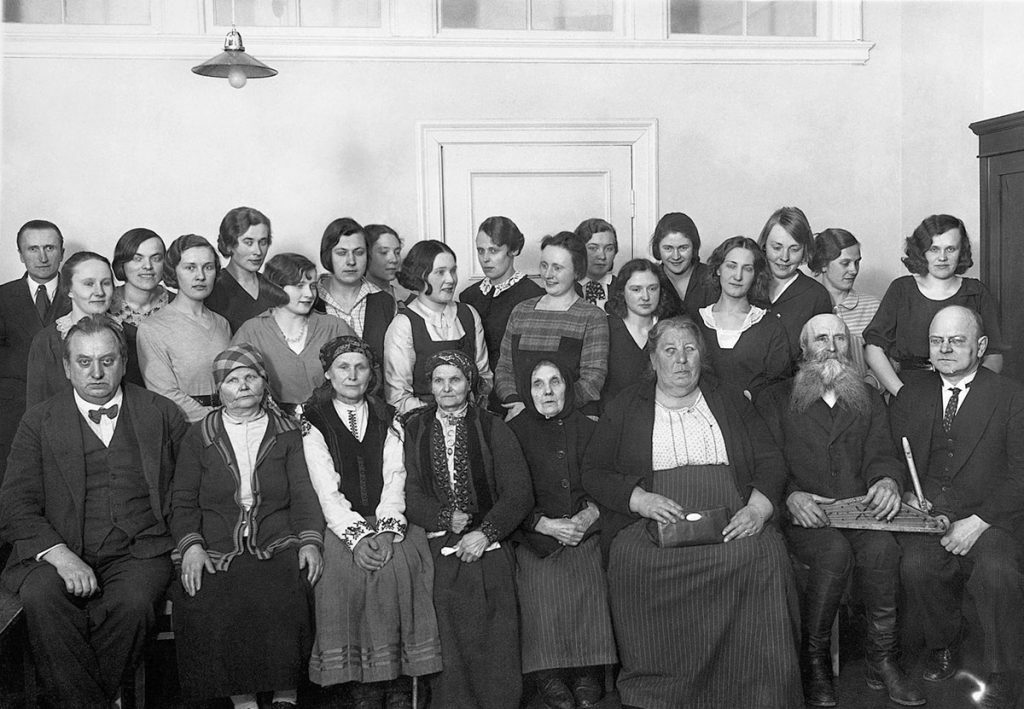
Niokolajs Heņķis in 1932, in the front, second from the right side
One kokle with neat decorations and pleasant sound is exhibited in the Ethnographic Open-Air Museum of Latvia. It was made by another Alsunga resident – Jānis Poriķis (1909-1992), who acquired not only the handicraft skills, but also musical techniques from N. Heņķis. J. Poriķis was also a proficient watchmaker. He was buried in Riga, cemetery of Jaunciems.

Jānis Poriķis, bagpiper 
In the front, from the left side – Andrejs Pētersons, Jānis Poriķis, in the background – Jāzeps Pinkulis, Marija Pinkule, Anna Pinkule, Otīlija Poriķe
Another well-known Alsunga resident was Pēteris Korāts (1871-1957), who was praised by E. Melgailis as an expert of national customs and music, as well as for his skills and craft of various national musical instruments. Especially for his innovations – he replaced the traditional kokle of 5-7 strings with 12-24 string instruments. While keeping the traditional shape of Kurzeme kokles, P. Korāts tried to find new expression for his instruments. Among the 17 kokles made by P. Korāts and collected in the Ethnographic Open-Air Museum of Latvia, the National History Museum of Latvia and Liepaja Museum, there are units with special handles, curved line of bridge pins and distinctive ornaments. There are blank, painted, cherry-red, mordanted and dipped kokles. Using fingers or plectrum from lime-tree or goose feather, Korāts demonstrated technique of virtuoso. He enjoyed playing together with pipe and bagpipe performers Pēteris Korāts is presumably buried in the area of Aizpute.
Another well-known Alsunga resident was Pēteris Korāts (1871-1957), who was praised by E. Melgailis as an expert of national customs and music, as well as for his skills and craft of various national musical instruments. Using his kokle making skills and experience passed down from his father Pēteris Korāts, he created kokles of various sizes with advanced technical abilities, by using tune switches. Several of his kokles, which demonstrate the master craft skills, are currently exhibited in the museums in Liepāja and Rīga.
Violin emerged in the Latvian folk music in the 17th century. Its significance grew on the brink of the 19th century. Violins were played at celebrations, in pubs and market squares. They gradually replaced bagpipes as the instrument for dance accompaniment.
Due to the cultural relations in late 19th century the Latvian daily music was greatly affected by the music of
To get to know about the musical life in the countryside 150-200 years ago, we should look into the roadside and church pubs. These were the places where the public life bubbled the most. People often crowded in pubs, being the centres of public life of that time. Here, in presence of musicians, the latest events were discussed, deals were sealed and work agreements were celebrated.
During the last century many more well-known and acknowledged musicians have lived in the Suiti district. The last real bagpiper was considered Pēteris Šeflers. Dūdinieku Krišs was famous in Jūrkalne. The last kokle player in Alsunga was Cērpu Lūcija. The last kokle player in Alsunga was Cērpu Lūcija. Besides kokle she played mouth-organ. Other great violinists were Kripa Jēkabs, Bišu Pēteris, Bišu Jozis, both Petrovskis, Jēkabs Jaunzemis (also a good actor, who repaired clocks and made rings). Ermoņikas spēlēja Kārlis Zvejnieks, Jāzeps Ruņģis un Vangu Kārlis Zvejnieks, Jāzeps Ruņģis and Vangu Ernests played mouth-organ. Mārtiņš Raģelis was known for cither playing. Alberts Vanags played saxophone, wind instruments and mandolin, as well as made adornments, produced banjo and played it.

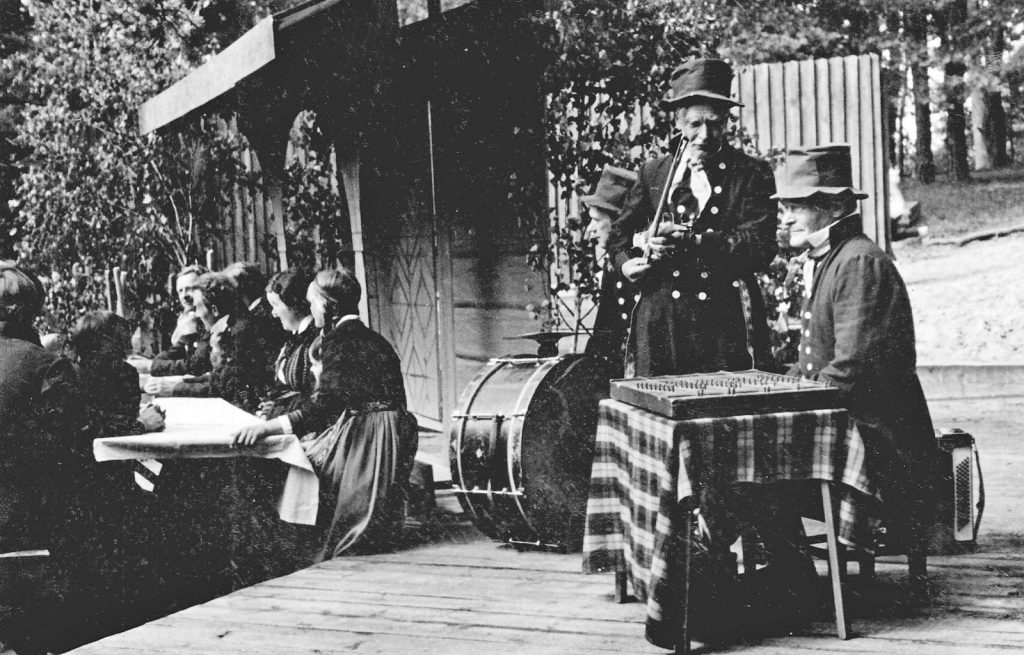

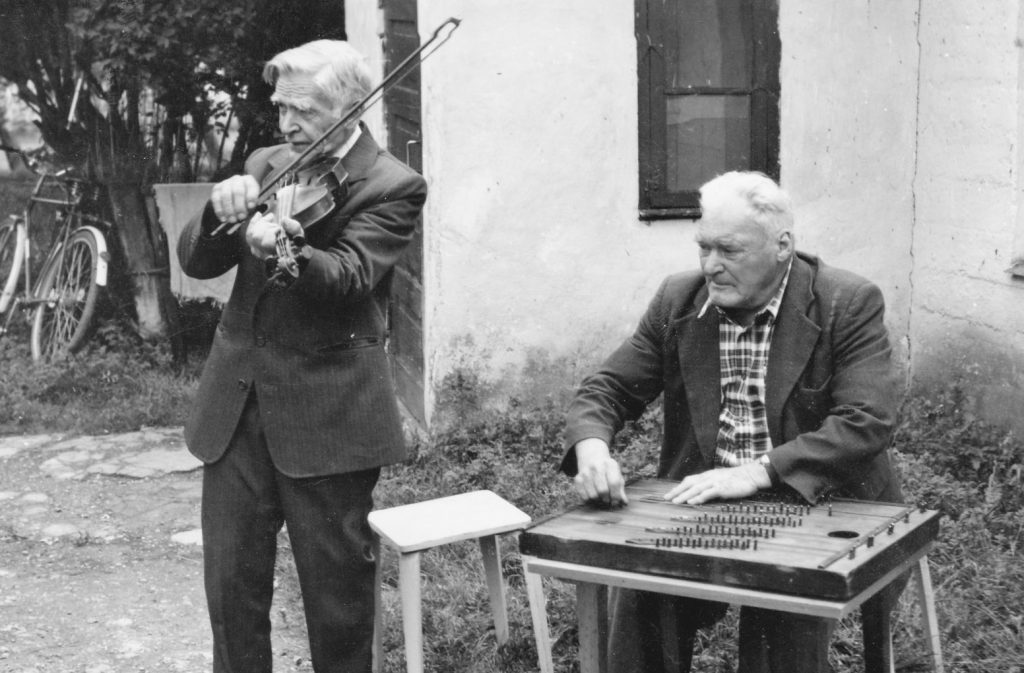
Jēkabs Kripa and Mārtiņš Raģelis

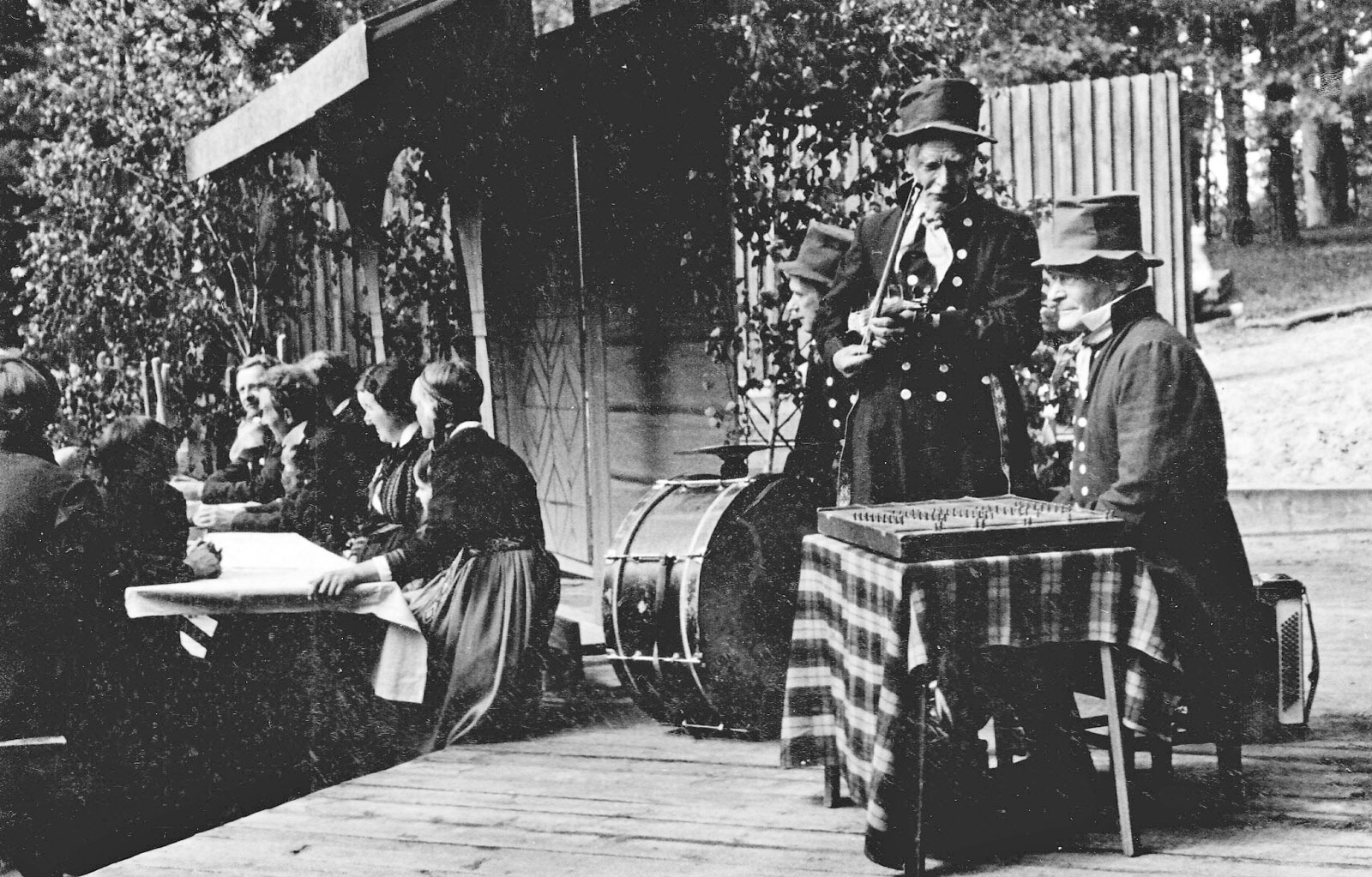


Jēkabs Kripa and Mārtiņš Raģelis Traditional music instruments are often mentioned in Latvian folk songs. The following numbers stand for the times the particular musical instruments were mentioned (Source: Īrisa Priedīte, “Ko spēlēja sendienās”, “Zinātne”, Rīga 1983.):
Trumpet – 233 times
Kokle – 227 times
Pipe – 222 times
Drums – 219 times
Buccina – 84 times
Violin – 71 times
Trideksnis – 38 times
Spēles ( type of musical bow) – 34 times
Bagpipes – 9 times
Short flute – 9 times
Zvārguļi (type of crotal) – 8 times
Deer horn – 7 times
Pūšļa vijole (bagpipe) – 5 times
Cembalo – 5 times
Dižā base (a type of bass) – 3 times
Ģīga (similar to monochord) – 2 times.